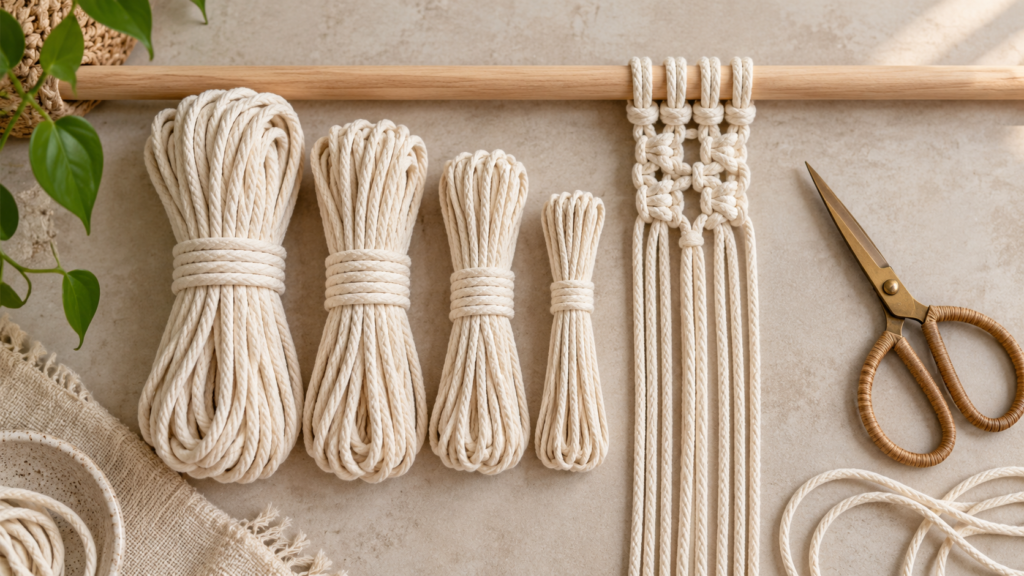
Macramé cord use depends on the finished width, knot sequence, cord thickness and hanging allowance. There is no single length that fits every wall hanging. Plan the layout and make a small knot sample before cutting the full set.
Sketch the finished shape
Mark the dowel or ring width and the width you want the finished work to occupy. Draw the main knot groups and leave space between them. This shows how many working cords you need and where the design will narrow or widen.
Read the pattern before cutting
Check whether the pattern gives cut lengths for each cord or gives a finished dimension. Note how each length is folded over the dowel, ring or mounting loop; the attachment uses part of the cord. Keep different lengths separate and label them by position.
Test a repeat
Use a short offcut to tie one repeat of the knot sequence. Measure how much cord the knots consume and compare the result with the pattern’s estimate. Thick cord, tight knots and long diagonal sections can use more material than a loose sample.
Allow for the hanging finish
Decide how you will finish the bottom edge before measuring the working cords. A fringe, wrapped bundle or row of knots uses different amounts of cord. Keep enough length to trim the ends evenly after the piece is mounted.
Cut and organize
Cut the longest cords first, then tie or clip them in labeled groups. Keep the unused supply aside until the main pattern is complete. If a pattern provides its own lengths, follow those directions and treat the sample as a check, not a replacement.
Common planning mistakes
- Measuring only the dowel and ignoring the folded attachment.
- Using one cord length for working cords and filler cords.
- Cutting before testing a knot repeat.
- Trimming the fringe before the design is fully tied.
For a first project, choose a pattern that lists cord thickness, cord count and finished dimensions. Those details make the material plan easier to reproduce.