A gauge swatch tells you how many stitches and rows fit into the pattern’s stated measurement. It matters when the finished dimensions or yarn quantity depend on gauge. Use the same yarn, needles and stitch pattern as the project; a stockinette swatch cannot predict a textured cable or rib.
Make the swatch larger than the measure area
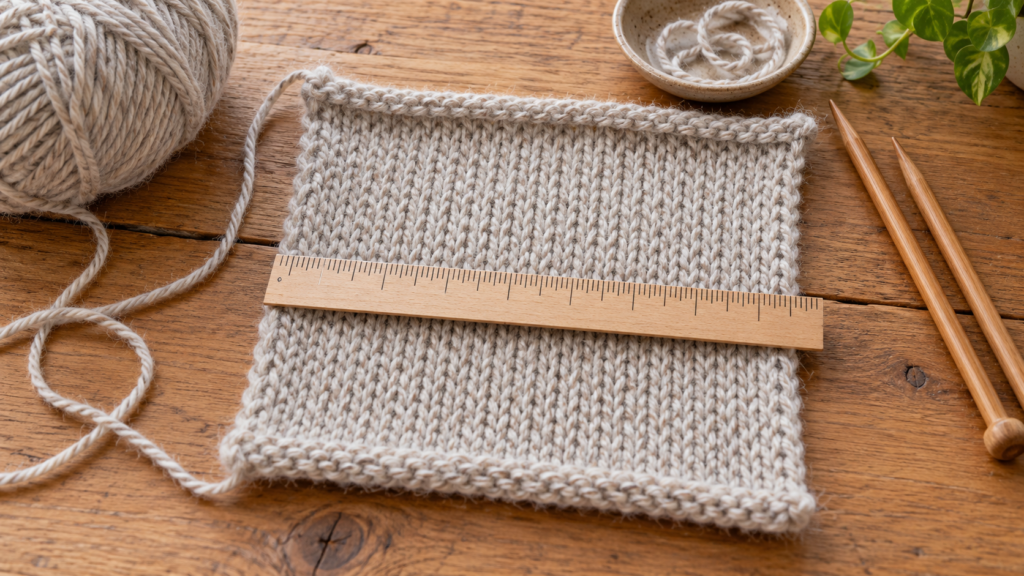
Cast on enough stitches to leave a stable center larger than the gauge square. Edge stitches can curl or spread, so do not measure right at the sides. Work the pattern stitch for enough rows to form a fabric sample, then bind off without pulling the top edge tight.
Finish it the way you will finish the project
If the pattern says to wash or block the garment, do the same to the swatch before measuring. Follow the yarn’s care label. Let the sample dry flat; stretching it to match the ruler can hide a gauge mismatch that will return later.
Measure the center
Place a ruler across the middle of the swatch and count the stitches in the pattern’s stated width. Repeat vertically for rows if the pattern gives a row gauge. The Craft Yarn Council recommends comparing a completed gauge swatch with the pattern; its hook and needle guide also explains how to adjust the tool size.
Change one thing at a time
If you have more stitches per inch than the pattern, your stitches are smaller; try a larger needle and knit another swatch. If you have fewer, try a smaller needle. Keep the yarn and stitch pattern the same while testing so the change is clear. If stitch gauge matches but row gauge does not, follow the pattern’s guidance: some designs use row counts, while others specify lengths in inches or centimeters.
For a scarf with no fixed dimensions, a swatch may be optional. For a fitted garment or a blanket made from a set number of squares, it can prevent a small gauge difference from changing the finished size.