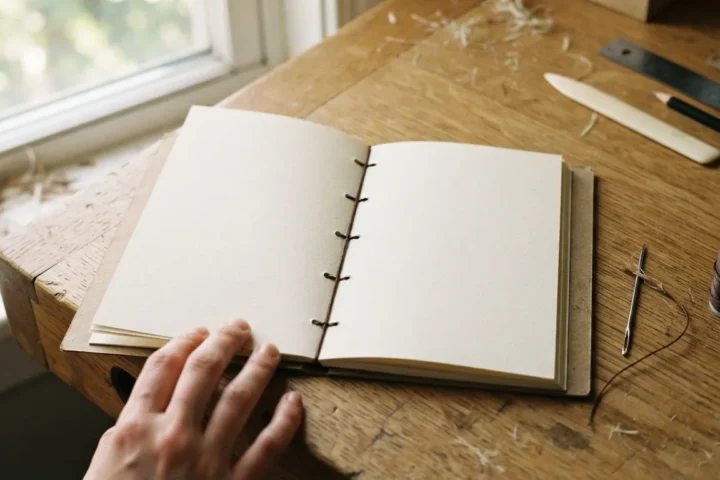
A three-hole pamphlet stitch binds one folded group of pages, called a signature, to a folded cover. This small booklet uses four letter-size sheets and a cover, so the finished page is about 5.5 × 8.5 inches.
Fold and align the signature
Fold four 8.5 × 11 inch sheets in half to make one signature. Nest the sheets, tap the folded edges against a flat surface and press the crease with a bone folder or the back of a spoon. Fold a cover cut to 11.5 × 9 inches and center the signature inside it. The cover will extend about a quarter inch beyond the pages.
Open the booklet to its center spread. Mark the fold at the middle and one inch from each end. Keep the marks on the crease; holes that drift off the fold can make the cover pull away from the pages.
Pierce the sewing stations
Set the open booklet on a scrap board. Use an awl or a large needle to pierce through all the sheets and cover at each mark. Keep the point perpendicular to the fold and your fingers clear of its path. Remove the board only after the point has passed through the stack.
Cut a length of thread about three times the spine height and thread a bookbinding needle. The Library of Congress pamphlet-stitch handout uses the same three-hole route and length rule.
Sew the spine
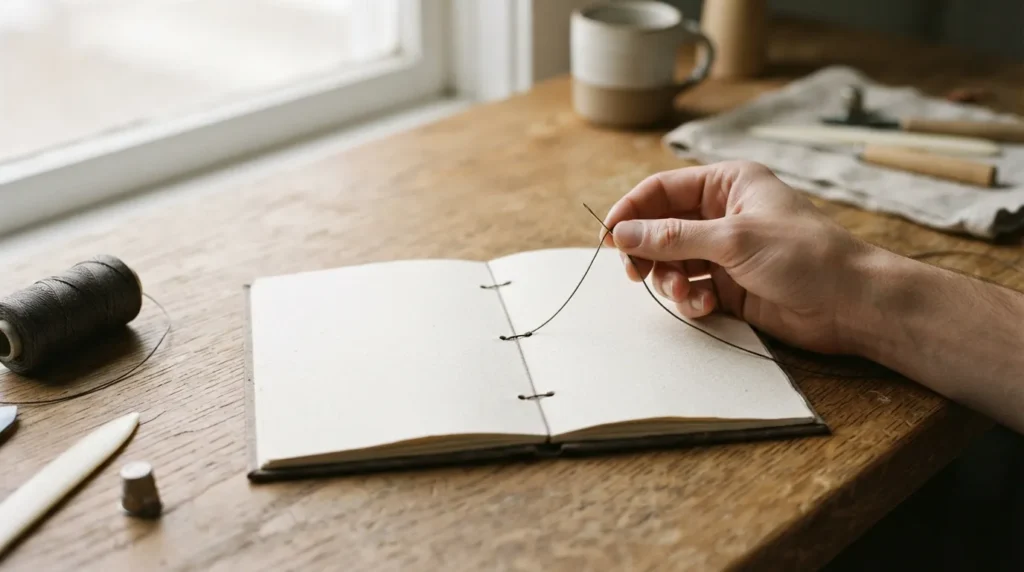
Start from the outside at the center hole and leave a short tail. Pass the needle through the center to the inside, then out through the top hole. On the outside, skip the center hole and pass the needle through the bottom hole. Bring it back through the center hole to the outside.
Check that the thread lies flat along the crease and that no pages slipped out of alignment. Tie the working end and the starting tail in a square knot around the long stitch running down the outside of the spine. Pull the knot snug enough to hold the pages without buckling the cover.
Finish and check the booklet
Trim the thread tails, leaving a small end rather than cutting close to the knot. Turn a few pages. If the cover bows or the pages shift, loosen the knot and even out the tension before tying again.
The pamphlet-stitch sketchbook project uses these measurements for a blank book. For larger sheets, keep the same route but move the top and bottom holes farther from the ends so the paper does not tear at the spine.